




The LSU Digital Twin Symposium at Louisiana State University brought together industry leaders, researchers, and students to explore how digital twin technology is reshaping infrastructure, environmental resilience, healthcare, and national defense. Dean Vicki Colvin of the College of Engineering highlighted applications ranging from modeling the human body to military readiness, while industry partners including Amazon, Bentley Systems, and HNTB demonstrated how digital twins are improving safety, bridge inspection, petrochemical operations, and integrated system management.
Real-world case studies underscored the power of simulation. Forte and Tablada showcased how they digitally modeled Louisiana’s 2016 flooding to strengthen resilience planning, while Geomatics & Remote Sensing presented a digital twin of the Grand Canyon to support competitive bidding and modernization of water infrastructure. These examples illustrated how digital twins allow communities and companies to test solutions virtually before building in the physical world.
For Capital Area STEM, the symposium sparked exciting conversations about bringing these competencies into high school pathways. NASA’s John Vickers shared a compelling vision for collaboration:
“Capital Area STEM can enable a magic mirror where students can learn to decode the reality of our world. Introducing digital twins in high school fast-tracks every student, even hesitant learners, to harness the power to simulate their own future before they build it.”
Students in attendance saw that vision come to life. Ava R., a high school student who attended because of her interest in art and experience experimenting with Blender, said learning how buildings and environments could be digitally twinned opened her eyes to a new career direction. “I want to use my past experiences as the foundation for my future,” she shared, capturing how creative skills can translate directly into emerging technical fields.
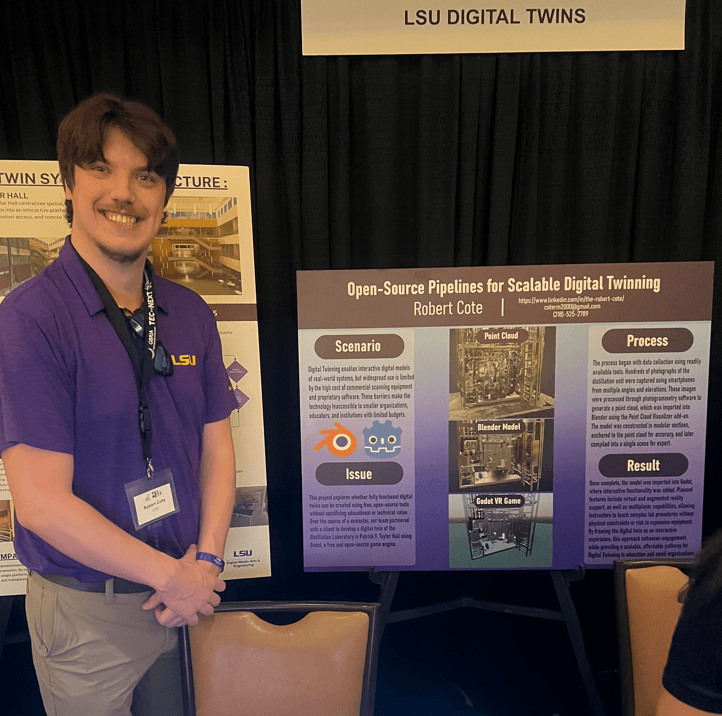
The symposium also recognized outstanding student innovation. First place in the digital twin competition went to Robert Cote, a graduate student in LSU’s Digital Media Arts & Engineering program, for developing open-source pipelines for scalable digital twinning. Second place was awarded to Katy Tye, a Ph.D. student in the College of Art & Design, and Isabella Keeley, a graduate student in the LSU Center for Computation & Technology. Together, the event demonstrated that digital twin technology sits at the intersection of art, computation, engineering, and industry and that the future workforce pipeline can begin as early as high school. With its strength across manufacturing, agriculture, coastal resilience, and flood modeling, Louisiana is uniquely positioned to lead the way into a smarter, more resilient digital future.
Thank you to Ann Trappey, CASN Board Member, and our partners at Forte and Tablada for making this possible.